Tuesday, November 8, 2016

About Page

NAKAANTS MEMBER :

Nama      : Nikodemus Adriel Limanthie
Email      : nikodemus.limanthie@tokopedia.com

Nama      : Mesquita Prasetyo
Email      : mesquitaprasetyo@yahoo.com
Twitter    : mesquitapras

Nama      : I Made Agus Adi Wirawan
Email      : i.wirawan@tokopedia.com

Nama      : Josefh Hasudungan Simanjuntak
Email      : josefh.simanjuntak@tokopedia.com

Nama      : Rikcat Kristian Lumban Gaol
Email      : rikcat.gaol@tokopedia.com

IF YOU ANY QUESTION PLEASE CONTACT US


Contact Us

Interesting Facts


Semut adalah makhluk keren. Mereka telah ada sejak zaman dinosaurus dan sekarang dapat ditemukan hampir di mana-mana di bumi. Mereka hidup dalam koloni yang berjumlah ratusan di mana setiap orang memainkan peran. Mereka membangun sarang dengan berbagai terowongan bawah tanah dan ruang. Mereka bekerja keras, terus-menerus mencari makanan. Mereka juga bisa berbahaya, dengan semut pemanen secara luas dianggap sebagai serangga yang paling berbisa dan semut bulldog yang bertanggung jawab untuk beberapa kematian di Australia. Dan apakah Anda tahu mereka bisa menjadi aneh juga? Berikut adalah beberapa fakta aneh dan menyenangkan tentang semut yang mungkin tidak tahu tentang.


There is a supercolony of ants that stretches over more than 3,000 miles in Europe.


Argentine ants accessing a commercial bait station commonly available in the United States. By Thmazing, PD image.

Argentine ants are special in that the new queens do not go off to start their colony from scratch. Rather, they branch off from the main colony, taking a few workers with them. Because of this, supercolonies form and one of them is taking over southern Europe. Scientists took specimens from various nests in France, Italy, Portugal and Spain and as it turned out, they all belonged to the same supercolony, refusing to fight each other.
Argentine ants have also spread to mainland USA, Hawaii, Australia, Japan and New Zealand. All of these are large supercolonies of their own, making scientists fear that they may one day become a nuisance.


Ants can lift objects up to 50 times their body weight.


Ants are strong insects. In fact, they can easily carry much more than they weigh. This is considering ants have strong muscles yet are very light. Elephants have strong muscles, too, but because they are heavy themselves, they can only lift up to 25% their own weight.They have to carry their own weight, too, after all.
Most ants can carry up to 50 times their body weight. Some can even carry up to 5,000 times their body weight, which is amazing, considering most of that weight is carried on their strong, flexible necks.


If the queen ant dies, the whole colony dies with her.


Queen and brood of the slave-maker Polyergus lucidus with Formica archboldi workers. Image credit: Adrian A. Smith, (CC BY 2.5)

In a bee colony, when the queen dies, a new one is chosen from among the larvae, fed royal jelly and raised to become the new queen. In most ant colonies, when the queen ant dies, the colony eventually dies off. This is because although all of the ants in the colony are females, only the queen ant can lay eggs and after she dies, no one takes her place and so no new members are added.
How does the queen ant die? Believe it or not, some queen ants are killed by her own rampaging worker ants, who either sting her to death or do not bring her food. Whether or not they are aware that they are killing off the colony by doing so remains a mystery.


Some army ants are used to stitch wounds.


If you ever found yourself with a bleeding wound in the middle of the forest and don’t have any bandages or needles and thread to stitch it with, don’t despair. Who knows? You might stumble across some army ants.
Stumbling across army ants is usually not good news because of their painful bite and their voracious appetite, attacking and consuming just about any creature in their path. But if you have a bleeding wound, army ants can do you some good. That’s because once they bite, they don’t let go, not even for a time after they’re dead. If you let them bite on either side of a gaping wound, the wound will close temporarily so the bleeding will stop and eventually, the wound will heal permanently.
Think this is a joke? The people in South America and Africa have actually been doing this in place of surgical sutures for centuries.


Animal Anatomy and Biology


Ants are eusocial insects of the family Formicidae and, along with the related waps and bees, belong to the order Hymenoptera. Ants encolved from wasp-like ancestors in the Cretaceous period, about 99 million years ago and diversified after the rise of flowering plants. More than 12,500 of an estimated total of 22,000 species have been classified. They are easily identified by their elbowed antennae and the distinctive node-like structure that forms their slender waists.

Ants range in size from 0.75 to 52 millimetres (0.030–2.0 in), the largest species being the fossil Tytanomyrma giganteum, the queen of which was 6 centimetres (2.4 in) long with a wingspan of 15 centimetres (5.9 in).

How do ants breathe?

Ants breathe in oxygen with trakea through spiracles which are a series of holes located around the sides of their bodies.
The spiracles are connected through a network of tubes which help distribute the oxygen to almost every cell in their body.
Their movement helps the oxygen to circulate through the tubes, with the released carbon dioxide exiting through said tubes as well.

How long do ants live?

The lifespan of ants depends on the caste. Males live for only a few weeks and die after mating. Workers usually live for several months. Queens can live for decades under the right conditions.
Ants are active all year long in tropical climates. In cooler climates, they survive the winter by going into a state of dormancy or inactivity known as Diapause.

Ants Physical Characteristic 

External

ant_anatomy_external 
Head – houses the compound eyes, antenna and muscles that power the mandibles.
Compound eyes – ants have poor eyesight, they have many small eyes placed next to each other. This enables them to see close movement.
Antenna – used to smell, touch, feel and communicate with other ants. Attached to the front of the head, they can move in-front and behind the ant.
Mandibles – used for cutting, holding, fighting, and digging. There are smaller mouthparts for chewing food.
Thorax – all the legs and wings are attached to the thorax.
Legs – are strong and flexible, they have claws on the end of each leg for grasping. Front legs used to touch objects and cleaning its body.
Claws – used to grip onto different surfaces, when on glass, the claws withdraw and a moist pad allows for adhesion.
Gastor – is part of the abdomen. It contains vital organs, it is has a telescoping construction of seven segments that gives this large area flexibility.
Stinger – is used to inject formic acid into victims. Not all species have a stinger, but they can still spray acid into wounds.


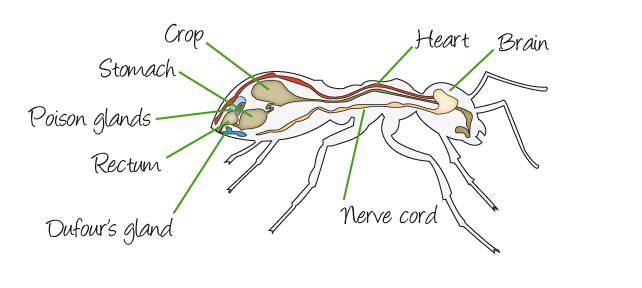
Internal

ant_anatomy_internal

Brain - Allows the ant to remember, think and react to its environment.
Heart - Shaped like a tube running through the ant, it surrounds the internal organs with a colourless blood.
Nerve cord - sends electronic messages through out the ants body, helping coordinate movement.
Crop - holds the ants social food it will share with the colony.
Stomach – where the ant digests its own food with acids.
Rectum - holds the waste products which will be deposited in the colonies designated waste area.
Poison glands - holds formic acid, which is sprayed andor injected as a defensive or attacking system.
Dufour’s gland - is believed to partly be involved with the production of chemicals that guide other ants and perhaps the attraction of mates.