
Ants are eusocial insects of the family Formicidae and, along with the related waps and bees, belong to the order Hymenoptera. Ants encolved from wasp-like ancestors in the Cretaceous period, about 99 million years ago and diversified after the rise of flowering plants. More than 12,500 of an estimated total of 22,000 species have been classified. They are easily identified by their elbowed antennae and the distinctive node-like structure that forms their slender waists.
Ants range in size from 0.75 to 52 millimetres (0.030–2.0 in), the largest species being the fossil Tytanomyrma giganteum, the queen of which was 6 centimetres (2.4 in) long with a wingspan of 15 centimetres (5.9 in).
How do ants breathe?
Ants breathe in
oxygen with trakea through spiracles which are a series of holes located around
the sides of their bodies.
The spiracles are connected through a network of tubes which help
distribute the oxygen to almost every cell in their body.
Their movement helps the oxygen to circulate through the tubes,
with the released carbon dioxide exiting through said tubes as well.
How long do ants live?
The lifespan of ants depends on the caste. Males live for only a
few weeks and die after mating. Workers usually live for several
months. Queens can live for decades under the right conditions.
Ants are active all year long in tropical climates. In cooler
climates, they survive the winter by going into a state of dormancy
or inactivity known as Diapause.
Ants Physical Characteristic
External

Head – houses the compound eyes, antenna and muscles that power the mandibles.
Compound eyes – ants have poor eyesight, they have many small eyes placed next to each other. This enables them to see close movement.
Antenna – used to smell, touch, feel and communicate with other ants. Attached to the front of the head, they can move in-front and behind the ant.
Mandibles – used for cutting, holding, fighting, and digging. There are smaller mouthparts for chewing food.
Thorax – all the legs and wings are attached to the thorax.
Compound eyes – ants have poor eyesight, they have many small eyes placed next to each other. This enables them to see close movement.
Antenna – used to smell, touch, feel and communicate with other ants. Attached to the front of the head, they can move in-front and behind the ant.
Mandibles – used for cutting, holding, fighting, and digging. There are smaller mouthparts for chewing food.
Thorax – all the legs and wings are attached to the thorax.
Legs – are strong and
flexible, they have claws on the end of each leg for grasping. Front
legs used to touch objects and cleaning its body.
Claws – used to grip onto different surfaces, when on glass, the claws withdraw and a moist pad allows for adhesion.
Gastor – is part of the abdomen. It contains vital organs, it is has a telescoping construction of seven segments that gives this large area flexibility.
Stinger – is used to inject formic acid into victims. Not all species have a stinger, but they can still spray acid into wounds.
Claws – used to grip onto different surfaces, when on glass, the claws withdraw and a moist pad allows for adhesion.
Gastor – is part of the abdomen. It contains vital organs, it is has a telescoping construction of seven segments that gives this large area flexibility.
Stinger – is used to inject formic acid into victims. Not all species have a stinger, but they can still spray acid into wounds.
Internal
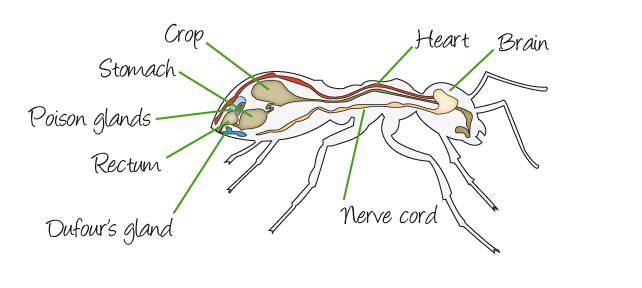
Brain - Allows the ant to remember, think and react to its environment.
Heart - Shaped like a tube running through the ant, it surrounds the internal organs with a colourless blood.
Nerve cord - sends electronic messages through out the ants body, helping coordinate movement.
Crop - holds the ants social food it will share with the colony.
Heart - Shaped like a tube running through the ant, it surrounds the internal organs with a colourless blood.
Nerve cord - sends electronic messages through out the ants body, helping coordinate movement.
Crop - holds the ants social food it will share with the colony.
Stomach – where the ant digests its own food with acids.
Rectum - holds the waste products which will be deposited in the colonies designated waste area.
Poison glands - holds formic acid, which is sprayed andor injected as a defensive or attacking system.
Dufour’s gland - is believed to partly be involved with the production of chemicals that guide other ants and perhaps the attraction of mates.
Rectum - holds the waste products which will be deposited in the colonies designated waste area.
Poison glands - holds formic acid, which is sprayed andor injected as a defensive or attacking system.
Dufour’s gland - is believed to partly be involved with the production of chemicals that guide other ants and perhaps the attraction of mates.

No comments:
Post a Comment